

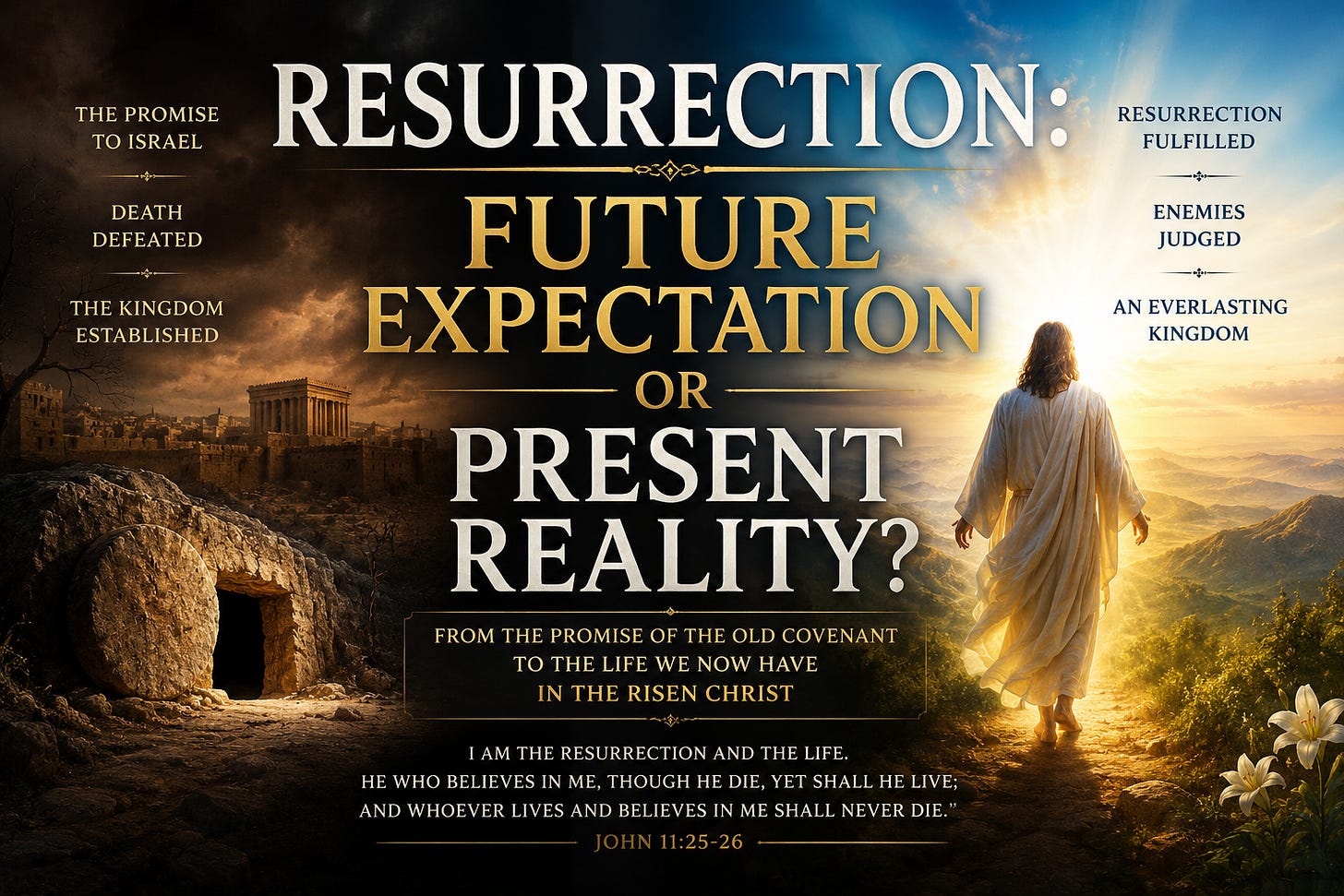
One of the most significant assumptions brought to the study of biblical eschatology is that the Bible presents only one kind of resurrection, one kind of death, and one universal expectation extending indiscriminately across both covenants. Yet when Scripture is allowed to speak in its own covenantal context, a different picture begins to emerge. The resurrection hope proclaimed throughout the Old Testament was not presented as an abstract doctrine about the end of world history. Rather, it was inseparably connected to the coming of Israel’s Messiah, the vindication of God’s covenant people, the destruction of His enemies, the establishment of His everlasting kingdom, and the close of the age governed by Moses. The New Testament does not relocate those expectations thousands of years into the future. Instead, it repeatedly declares that they were standing at the very threshold of fulfillment. Once that covenantal resurrection had occurred, believers under the New Covenant were no longer described as waiting to be raised from the dead in the same covenantal sense. Instead, they were said already to have been raised with Christ through regeneration, justification, adoption, and union with Him.
The Old Testament consistently binds together several great themes. The Messiah would come. He would judge God’s enemies. He would deliver His people. He would establish an everlasting kingdom. He would raise the dead. These were never presented as unrelated events. Psalm 2 announces that God’s Anointed King would inherit the nations and crush His enemies with a rod of iron. Psalm 110 pictures the Messiah seated at God’s right hand until His enemies are made His footstool, ruling in the midst of His enemies while judging the nations. Isaiah 9 declares that the government would rest upon His shoulders and that of His kingdom there would be no end. Isaiah 11 describes the Branch of Jesse judging in righteousness while filling the earth with the knowledge of the Lord. Isaiah 25 joins together the destruction of God’s enemies, the removal of the veil over the nations, and the swallowing up of death forever (Isaiah 25:6-9). Isaiah 26 continues by proclaiming, “Your dead shall live; their bodies shall rise” (Isaiah 26:19), immediately before describing the Lord coming out of His place to punish the inhabitants of the land (Isaiah 26:20-21). Ezekiel 37 portrays the resurrection of the dry bones as the restoration and vindication of covenant Israel under David, their king. Hosea promises, “After two days He will revive us; on the third day He will raise us up” (Hosea 6:2), while later declaring that God will ransom His people from Sheol and redeem them from death (Hosea 13:14). Finally, Daniel 7 speaks of the Son of Man receiving an everlasting kingdom after judgment falls upon the beast, and Daniel 12 announces that at “that time” Michael would stand, there would be unprecedented tribulation, God’s people would be delivered, and “many of those who sleep in the dust of the earth shall awake” (Daniel 12:1-3). The sequence is unmistakable. Tribulation. Judgment. Kingdom. Resurrection.
Read Full Article: https://thewashingtonstandard.com/resurrection-future-expectation-or-present-reality-from-daniels-hope-to-christs-fulfillment/
