

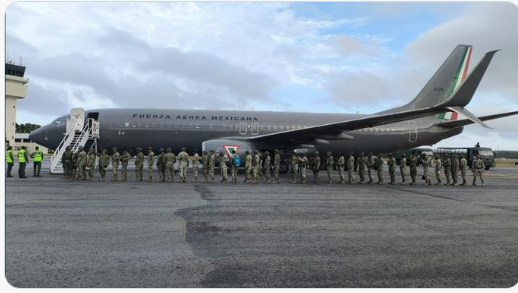
Something serious is unfolding on America’s southern frontier. As President Trump signals a harder line against the cartel empires strangling Mexico, troop movements, security surges, and political panic are rippling across the border. Mexico’s government is scrambling — not because it wants war, but because it knows how deeply the cartels are woven into its own institutions. This is the moment no one wanted but everyone feared. For decades, criminal syndicates turned entire regions into shadow states. Now the world’s most powerful nation is openly questioning whether that can continue. When Washington talks about “hitting land,” it stops being about drugs and starts being about sovereignty. That’s why you’re seeing: • sudden security buildups • emergency meetings • hardened rhetoric • and frantic messaging For years, the cartels have operated like a parallel state inside Mexico — with their own armies, their own territory, and their own billions. Now the United States is openly talking about dismantling that system at its core. That terrifies everyone who benefits from it. So when soldiers start moving, it’s not about stopping migrants or guarding fences. It’s about positioning — about signaling — about preparing for a moment that could shatter the status quo. Because once a superpower decides the cartels are no longer just criminals, but a national-security threat, the rules change. And right now, the border feels less like a line on a map… …and more like the edge of a storm.
MEXICO IN THE CROSSHAIRS President Trump has just dropped one of the most explosive national-security statements in years: After claiming 97% of maritime drug routes have been shut down, he says the U.S. will now “start hitting land” to confront the cartels — declaring that “the cartels are running Mexico.” This is not rhetoric about borders or visas. This is the language of counter-insurgency. Trump is framing the cartels not as criminals, but as a hostile force — one that: • controls territory • moves weapons • destabilizes a neighboring state • and kills Americans by the hundreds of thousands through narcotics In Washington terms, that’s not crime. That’s a national security threat. If this line holds, everything changes: Diplomacy. Border policy. Military posture. The U.S.–Mexico relationship itself. We are watching the moment where the War on Drugs is being redefined as something far more dangerous — and far more consequential. This is no longer about stopping smugglers. It’s about whether the United States is prepared to confront a parallel power operating next door.
