

Order Michael Finch’s new book, A Time to Stand: HERE. Prof. Jason Hill calls it “an aesthetic and political tour de force.”
“We’re saying Merry Christmas again!” President Trump declared recently, referring to the politically correct social pressure Christians sometimes feel to downplay the holiday greeting in order to be more “inclusive” of non-Christians. For decades now, as the culture has become more secular, references to Christ have been gradually drained from the season celebrating His birth: schools have changed “Christmas break” to “winter break”; Christmas tree lighting ceremonies have become “Winter” or “Holiday” tree lightings; and most notoriously, “Happy Holidays” has replaced “Merry Christmas” in many chain stores, advertisements, and corporate settings.
Some claim that the idea of a “war on Christmas” in America is overstated – that’s debatable – but there unquestionably is one being waged in Europe: a war of attrition, as the surging Islamization of the continent formerly known as Christendom further marginalizes a Christianity already in steep decline. As globalist elites like the leadership of the European Union prioritize avoiding offense over preserving heritage, Christian symbols and nomenclature are increasingly sidelined or excised. And as mass Muslim immigration reshapes demographics and imports jihadist violence to the continent, Christmastime now brings more security concerns than holiday joy.
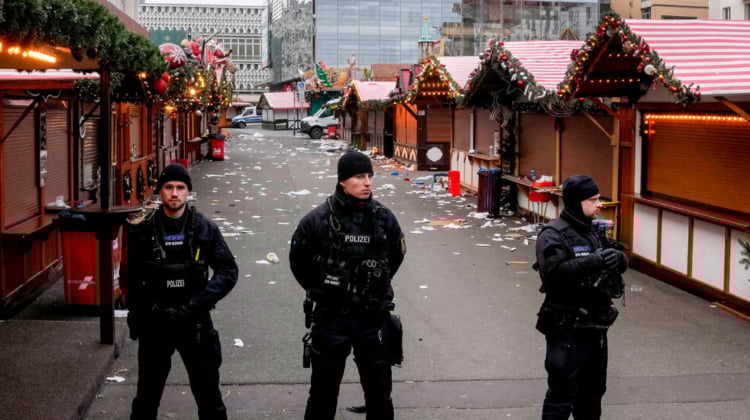
Below are four examples from just the last month alone, in which Christmas markets or celebrations in Europe have been either fully shut down or placed under significantly heightened security measures due to elevated terror threats. These stem from ongoing concerns about incidents like the 2024 Magdeburg attack in which a Saudi refugee living in Germany killed 6 people and injured 338 others by plowing his car through a Christmas market. This and numerous past jihadist attacks at Christmas have made concrete barriers, patrols, surveillance, and in some cases, cancellations common:
The Overath Christmas market, a traditional event in this German town of about 27,000 residents, was fully canceled for 2025. Organizers cited an inability to afford the mandatory anti-terror measures, including barriers, surveillance systems, and extra guards required by authorities after the Magdeburg attack;
The Warsaw Christmas market has been fortified with extensive concrete barriers and barriers installed around key sites to prevent vehicle ramming attacks. This response to high Islamist terror fears has transformed the event into a heavily patrolled zone, with Polish authorities echoing European-wide alerts for large gatherings during the holiday season;
France’s Interior Ministry has ordered “maximum vigilance” and enhanced protections for the Strasbourg market, including soldier deployments for visible deterrence, additional checkpoints, and intelligence mobilization. This follows a “very high” terror threat level, referencing the 2018 ISIS-inspired attack that killed five at the same site, with similar vehicle-ramming risks noted across the country;
Germany is being hammered by soaring security costs (up 44% in three years) due to persistent threats. Frankfurt am Mainhas shelled out £3,480,000 for Christmas-market anti-vehicle and crowd-protection systems. Dresden has spent £1,479,000 on reinforced access protection, mobile vehicle stoppers and perimeter lock-down equipment. Berlin’s iconic Breitscheidplatz market, where a 32-tonne truck was driven through crowds leaving 12 dead in 2016, has paid out £157,000 for private security and protective entry controls.
Read Full Article: https://www.frontpagemag.com/european-christmas-goes-on-lockdown/
